Our services
Cedar Siding Repair in Dayton, OH
Gray, cupped, split or stained cedar? We fix the cause, replace only the failing boards and refinish your cedar with stain or paint to protect it.
Cedar is one of the best woods for siding. It is naturally resistant to rot and insects, it holds its shape well and it looks great for a long time. But cedar is still wood, and after years of Ohio sun, rain and freeze-thaw cycles it needs attention. The good news is that most cedar problems can be repaired without replacing the whole wall. We find what is causing the damage, replace only the boards that are failing and refinish the siding so it is protected again.
Common cedar siding problems
Cedar fails in its own ways. These are the issues we see most often on cedar homes around Dayton:
- Weathering and graying: when the finish wears off, the sun breaks down the surface and cedar turns gray and rough. It looks tired, and bare wood absorbs water.
- Cupping and warping: boards that get wet on one side and dry on the other can curl at the edges and pull away from the wall.
- Splitting and cracking: cedar is soft, so splits can open along the grain, often at nail holes and board ends.
- Stain failure: stain that has faded, peeled or worn unevenly, especially on south- and west-facing walls.
- Tannin bleed: cedar contains natural tannins that can bleed through light paint as brown or orange stains, especially after rain.
- Fastener stains: black streaks around nail heads, often from nails that react with the wood.
- Rot at problem spots: even cedar rots where water sits, such as low courses, corners, butt joints and under leaking gutters.
How we repair cedar siding
Find the cause
Cupping, splitting and rot almost always point to water: a gutter overflowing, missing flashing, siding too close to a roof or the ground, or failed caulk. We look for the source first, because new cedar will fail the same way if the cause is not fixed. If the damage has spread to trim or fascia, our fascia, soffit and trim repair service covers that too.
Replace only the damaged boards
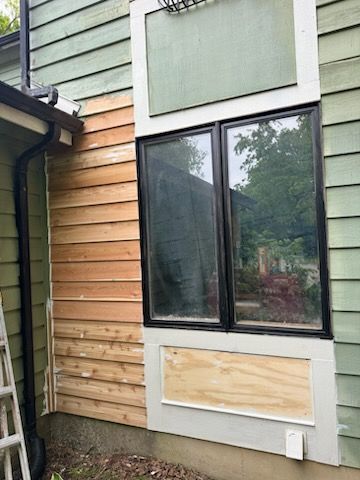
We remove boards that are rotted, badly split or cupped beyond saving and install new cedar matched to your profile and reveal. Each new piece is primed or sealed on all sides, including cut ends, before it goes up, so moisture cannot soak in from behind. Boards that are sound but have small checks or loose nails can often be refastened and kept.
Matching aged cedar
New cedar is lighter and redder than boards that have been on the wall for years, so a fresh board can stand out at first. How we handle that depends on the finish. On painted cedar, primer and paint make the repair blend in. On stained cedar, we talk with you about the best way to even out the color, which may mean staining the repaired wall or the whole house so the new and old boards read as one surface. We are careful with color matching, and we will be honest about what to expect.
Stain or paint for cedar?
Both can work well on cedar, and the right choice depends on the look you want and how much upkeep you are comfortable with:
- Stain lets the grain and texture of the cedar show. It soaks in rather than forming a thick film, so it tends to wear away gradually rather than peel, but it usually needs to be refreshed more often.
- Paint forms a protective film and gives you full color choice. On cedar, a stain-blocking primer is important to keep tannins from bleeding through, especially under light colors.
If your cedar is currently painted, it usually makes sense to stay with paint. Going from paint back to a natural stain is a much bigger job. We will walk you through the options when we look at your house.
Refinishing cedar siding
Many cedar homes need refinishing more than they need new boards. Good prep is what makes a finish last: cleaning the surface, removing loose and failing material, sanding rough or gray areas, treating fastener stains and sealing open joints. Then we apply the stain or primer and paint with even coats. Our exterior painting page has more on how we prep and finish.
Repair first, honestly
Francisco, the owner, looks at every job himself. If your cedar only needs a few boards and a fresh finish, that is what he will recommend. If the damage is widespread, he will tell you that too and explain your options, including siding replacement. For general siding problems on other wood types, see our wood siding repair page.
Get a free cedar siding estimate
Upload a photo of your cedar siding on our free estimate form and we will tell you whether it looks like a repair, a refinish or a replacement. Or call or text (937) 789-7180, Monday through Friday, 7:30 am to 6:00 pm. We are licensed and insured, BBB Accredited (A+) and rated 4.9 stars on Google. We serve Washington Township, Centerville, Kettering, Oakwood, Sugarcreek Township, Bellbrook, Springboro, Clearcreek Township, Beavercreek, Miamisburg, Lebanon and West Chester.
Questions homeowners ask
Why is my cedar siding turning gray?
Gray cedar is a sign the finish has worn off and the sun is breaking down the surface of the wood. It is mostly cosmetic at first, but bare cedar absorbs more water and is more likely to split and cup over time. Cleaning, light sanding and a new stain or paint finish usually restore and protect it.
What causes brown or orange stains on painted cedar?
That is usually tannin bleed. Cedar contains natural tannins that can move through paint when the wood gets wet, especially under light colors. A proper stain-blocking primer helps prevent it, and we use that approach on new and refinished cedar.
Can cupped or warped cedar boards be saved?
Sometimes. Boards with slight cupping can often be refastened once the moisture problem is fixed. Boards that are badly cupped, split or soft are better replaced with matched cedar primed on all sides.
Will new cedar boards match my old, weathered siding?
New cedar starts lighter than aged boards. On painted siding, primer and paint make it blend in. On stained siding, we usually recommend staining the repaired wall or the whole house so the color reads evenly, and we will explain what to expect before we start.
Should I stain or paint my cedar siding?
Stain shows off the grain and tends to wear gradually instead of peeling, but usually needs refreshing more often. Paint gives full color choice and a protective film. If your cedar is already painted, staying with paint is usually the practical choice. We will help you decide based on your house and goals.
Recent work
See all our work →
Your home. Your peace of mind.
Seeing something like this on your house?
Honest recommendations. Quality workmanship. Personal care.
Get my free estimate